By Victoria Witke, Capital News Service
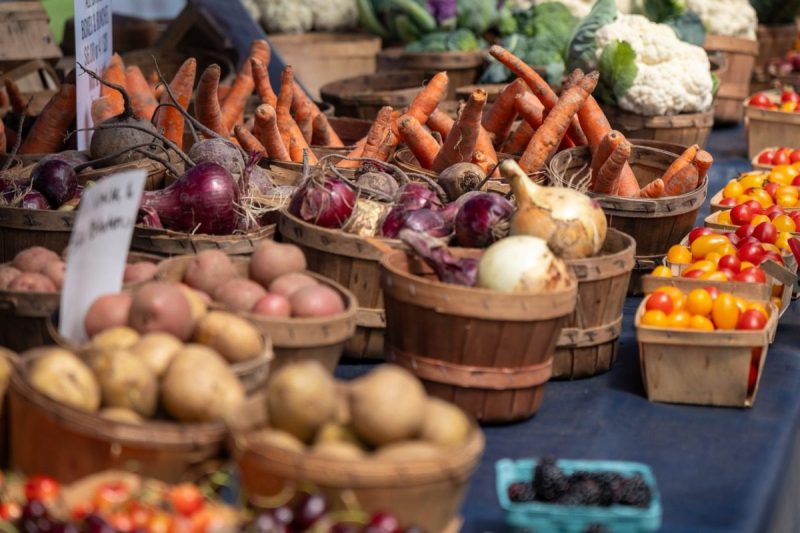
LANSING – Alex Canepa sells vegetables at his local farmers market in Washtenaw County’s Dixboro every Friday afternoon during the spring and summer.
“You can go and get your groceries, a hot meal and just hang out and meet your neighbors – it’s good for a community to have that kind of space, to have a place where you can get together and then build social capital,” Canepa said.
He runs a hobby farm in addition to his full-time job as the policy director at the Food Fair Network based in Detroit.
But his farm loses money every year.
“My part-time job is so that I can be outside with my son and grow food,” Canepa said. “But the main reason is that I love the farmers market and get to meet neighbors who I never would meet in the normal course of my day.”
The Dixboro Farmers Market near Ann Arbor – along with a majority of farmers markets in the state – accepts Supplemental Nutrition Assistance Program, or SNAP, benefits.
SNAP is a federal program that provides monthly benefits to buy food. Over 1.4 million recipients in the state receive benefits, according to the US Department of Agriculture – that was $3.06 billion in 2024.
In Michigan, the Double Up Food Bucks program matches each dollar spent on fresh produce with SNAP – families can thus buy twice the amount of fruits and vegetables. The money comes from the federal and state funds and philanthropy.
“It’s a way for farmers to make more money selling their food if people have more money to spend,” Canepa said.
The US House of Representatives aims to cut food assistance benefits in its latest budget resolution – a move that could mean less profit for small and mid-sized Michigan farms.
“Those programs represent demand for Michigan products,” said Tim Boring, the director of the state Department of Agriculture and Rural Development.
“So when you see these wholesale reductions in food support systems, that’s critical market demand for a lot of products we grow here,” Boring said.
Small fruit and vegetable farmers tend to sell at farmers markets, not to grocery store chains.
Up to 15% of a farmer’s sales come from SNAP dollars at some markets, said Joe Lesausky, the food access director of the Michigan Farmers Market Association based in East Lansing.
“That’s an impressive amount of additional sales they’re bringing in because the market is accepting those benefits,” Lesausky said.
If cuts to food assistance programs like Double Up happen, shoppers might have to choose between farmers markets and stores, Lesausky said.
“Every time those programs lose funding or have to shrink their budget, those choices are taken away from families,” Lesausky said. “They won’t be going to farmers markets if they’re splitting their budget between that and stores.”
Buying from farmers markets supports the local economy more than buying from grocery stores, Canepa of the Fair Food Network said.
“If we’re trying to support Michigan’s economy, we want to keep these benefit dollars in the state as opposed to supporting growers in other countries,” he said.
Local farms pay state and local taxes, hire employees and pay for community services.
“I’m a farmer,” Canepa said. “When my tractor breaks down, I hire a diesel mechanic who lives down the street from me. That’s money going into that mechanic’s pocket.”
“When I buy seed starts, fertilizer or compost, I’m supporting a local business,” he said.
He said when the local economy thrives, everyone does better.
Canepa said growing food is a source of strength and pride for Michigan communities – and outsourcing food is bad for community wellbeing.
“It’s our heritage,” Canepa said. “We can grow anything here – apples, cherries.”
“When you lose that, you lose something more important than just money,” he said.