
MICHIGAN—Every seat in the Michigan House of Representatives is on the ballot this November. The ‘Gander is profiling the races that could decide who controls Lansing.
Here’s what voters need to know ahead of Election Day in the 86th House District:
The race
Republican state Rep. Nancy DeBoer and Democratic challenger Joseph McClusky are running unopposed in the primary election. They’ll face off in the general election on Nov. 3.
The district
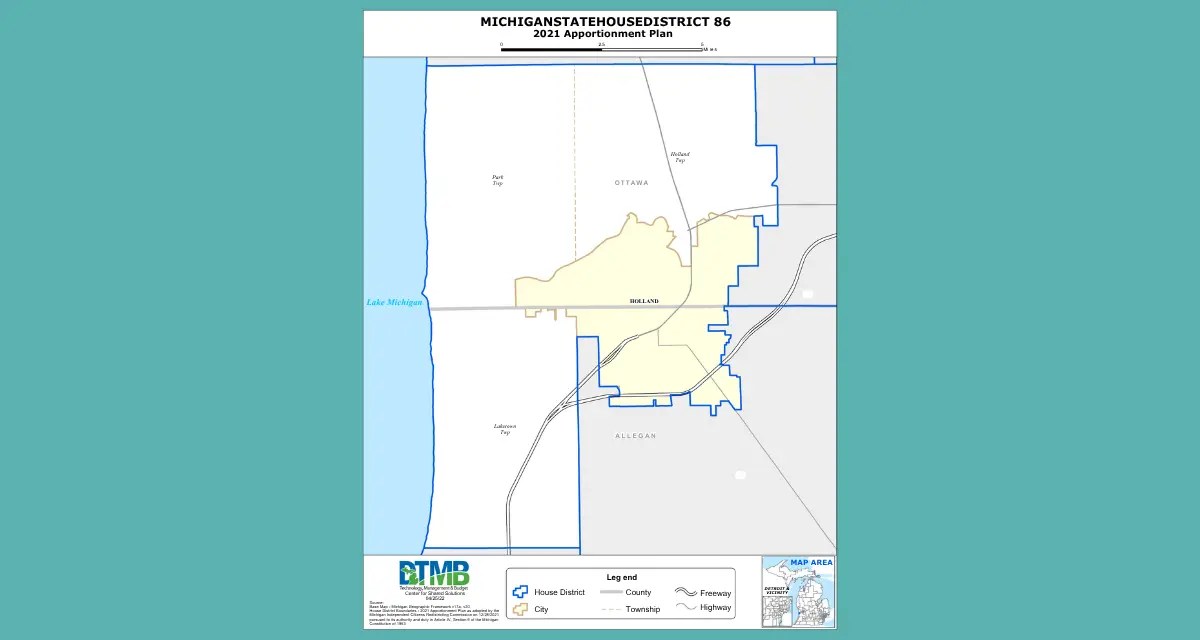
Michigan’s 86th House District includes Holland, most of Holland Township, and all of Park and Laketown townships in Allegan and Ottawa counties. It’s home to roughly 92,000 people.
DeBoer won this seat in 2022 with 56% of the vote and defended it by a similar margin in 2024.
But those margins don’t tell the whole story: President Donald Trump carried this district by a mere 0.3% of the vote in 2020, with even tighter margins reported in 2024. And the city of Holland has been sending signals of its own. Holland voters replaced DeBoer with a more progressive mayor in 2019; then re-elected him three times. All of which makes this a district Democrats believe is finally within reach this year—and one Republicans can’t afford to lose.
Nancy DeBoer (R)
DeBoer’s resume runs deep in Holland. She’s a former teacher who joined the City Council in 2005 and made history as the first woman elected as the city’s mayor, serving two terms.
A Grand Rapids native and Calvin College graduate, she also co-founded the now-defunct West Michigan Character Council and co-hosted a morning show on a local Christian radio station.
During her time as mayor, DeBoer oversaw a $16.5 million renovation of the Holland Civic Center, the replacement of the city’s aging coal plant with a new natural gas facility, and the expansion of the city’s downtown snowmelt system into the largest in North America.
But Holland was changing faster than its mayor, and her final year in office was a telling one. That summer, DeBoer went on a local radio show to voice her disapproval of a touring drag brunch coming to Holland—and the shows promptly sold out in record time.
A few months later, voters ousted her in favor of Nathan Bocks, a local real estate attorney who ran on a more progressive and inclusive vision for the city and still serves as the mayor today.
DeBoer, now 72, currently serves as the chairwoman of the state House Education and Workforce Committee and is a member of the Energy, Health Policy, and Rules committees.
Her recent legislative work includes a six-bill epinephrine access package that passed the House unanimously, bills to restrict cell phones in classrooms, and a $600,000 state grant to convert a shuttered US Coast Guard station into a water rescue base for Park Township.
She has also made literacy a signature issue—advancing bills to require phonics-based literacy training for Michigan teachers, as well as expanded services for students with dyslexia.
Some of the claims DeBoer makes about her own record, however, don’t hold up.
Her campaign website credits her with ensuring the passage of housing legislation “creating the state’s new Missing Middle housing program.” That program was actually created through the Building Michigan Together plan—a $4.8 billion infrastructure package signed by Gov. Gretchen Whitmer in March 2022, roughly nine months before DeBoer was sworn in for her first term.
DeBoer has also touted that she received the “2025 Habitat for Humanity of Michigan Legislator of the Year award.” But no such award exists. The distinction she actually received was the Sandra Pearson Advocacy Award, named for the organization’s longtime former CEO.
Then there’s the part of DeBoer’s record she doesn’t advertise at all: her positions on reproductive rights, LGBTQ+ equality, clean energy, and dark money in politics.
DeBoer has been endorsed by Right to Life of Michigan, an organization that supports abortion bans with no exceptions for rape or incest, as well as Citizens for Traditional Values, another anti-abortion group. She sponsored legislation to ban abortion after fetal viability, voted against every bill in the Reproductive Health Act, and voted against a bill banning Michigan employers from discriminating against workers who are pregnant or have terminated a pregnancy.
In 2011, as a member of the Holland City Council, DeBoer also voted against adding legal protections for LGBTQ+ residents into the city’s anti-discrimination ordinance. Holland ultimately adopted those protections in 2020—after she had left city government.
On the environment, DeBoer voted to repeal Michigan’s landmark clean energy laws—a move that helped earn her a 19% score from the Michigan League of Conservation Voters.
The League also notes that she has accepted at least $4,500 in campaign donations from corporate utility companies since taking office, including $2,500 so far this legislative session.
DeBoer has also appeared at events hosted by the LIBRE Initiative, a political group funded by the Koch network—one of the largest dark money operations in the country—that has spent the past year courting Latino voters across Michigan with free meals ahead of the 2026 midterms.
Her website lists her top priorities as childcare expansion, affordable housing, education reform, and “conservative principles of government.” Her endorsers include former US Rep. Pete Hoekstra, the Michigan Chamber of Commerce, and Ottawa County Sheriff Steve Kempker.
DeBoer currently lives in Holland with her husband, a longtime public school music teacher who now serves as a professor of music at Hope College. They have three children.
Joseph McClusky (D)
McClusky, a 28-year-old Hope College graduate, knows this district—and his opponent—better than most first-time state House candidates.
In 2022, he managed Democrat Larry Jackson’s campaign against DeBoer. In 2024, he served as a regional director for the Michigan House Democratic Fund, working with candidates across nine West Michigan districts. Now, he’s taking his own advice and running himself.
A Burton native who moved to West Michigan in 2015, McClusky reportedly grew up in a conservative Christian household and attended a Baptist school whose motto was “Training Soldiers for Christ.” He ran for president of the Hope Republicans as a college freshman and attended the 2016 Republican National Convention as a guest of the Michigan delegation.
But he said watching the party fuse itself to Trump—and coming out as gay during his senior year of college—convinced him there was no longer room for him in the Republican Party.
“I’ve been doing a lot of the work behind the scenes on campaigns, and it wasn’t a goal to run for office, but I’ve always said if I feel like I have something to offer, if I feel like I have something to say for the community, that I’ll step up and run,” McClusky told the Ottawa News Network.
His campaign is built on three pillars: affordability, accountability, and action—with a focus on housing costs, healthcare access, prevailing wage protections, and skilled trades programs.
On his campaign website, he pledges not to accept corporate PAC money and says he wants to subject the state Legislature and governor’s office to the Freedom of Information Act. He also says he supports expanding passenger rail connections between Holland, Detroit, and Chicago.
Ahead of Election Day, McClusky has been openly critical of DeBoer’s votes on school funding, including her support for a budget that eliminated funding for universal free school meals.
“We can and we must do better,” he told the Ottawa News Network. “And it’s time we elect somebody who’s going to enact some real, meaningful change in Lansing.”
McClusky has been endorsed by the League of Conservation Voters, Teamsters Local No. 406, Ottawa County Commissioner Doug Zylstra, Holland City Councilman Devin Shea, the Michigan Association for Justice, Run for Something, and Moms Demand Action, among other groups.
What’s at stake?
Control of the Michigan House of Representatives hangs on a handful of seats like this one.
Republicans hold a narrow majority there and Democrats need to flip some battleground districts if they want to regain the gavel in 2027. The 86th District is exactly the kind of race that will determine which party runs Lansing—and what gets done there—for the next two years.
Click here to make sure you’re registered to vote and to find your precinct. The only date that matters here: Nov. 3, 2026. Both candidates are running unopposed in the Aug. 4 primary.
READ MORE: How many AI data centers are planned in Michigan? We counted.
Don’t miss Michigan’s biggest stories—follow The ‘Gander on Instagram.