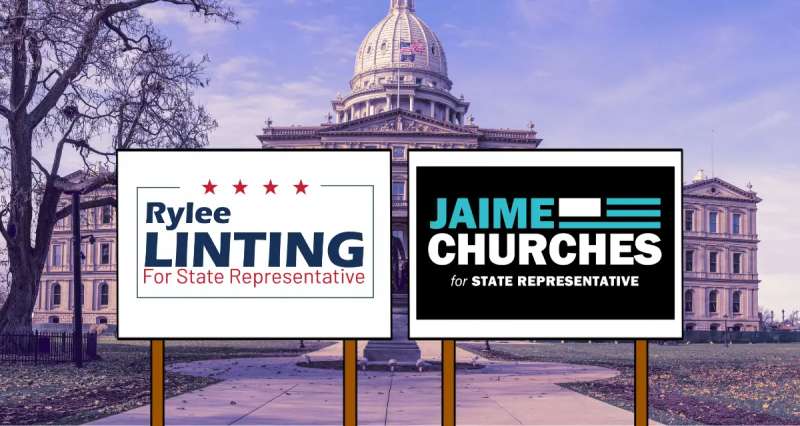
MICHIGAN—Every seat in the Michigan House of Representatives is on the ballot this November. The ‘Gander is profiling the races that could decide who controls Lansing.
Here’s what voters need to know ahead of Election Day in the 27th House District:
The race
Republican state Rep. Rylee Linting and Democratic challenger Jaime Churches are running unopposed in the Aug. 4 primary election. They’ll face off in the general election on Nov. 3.
The district
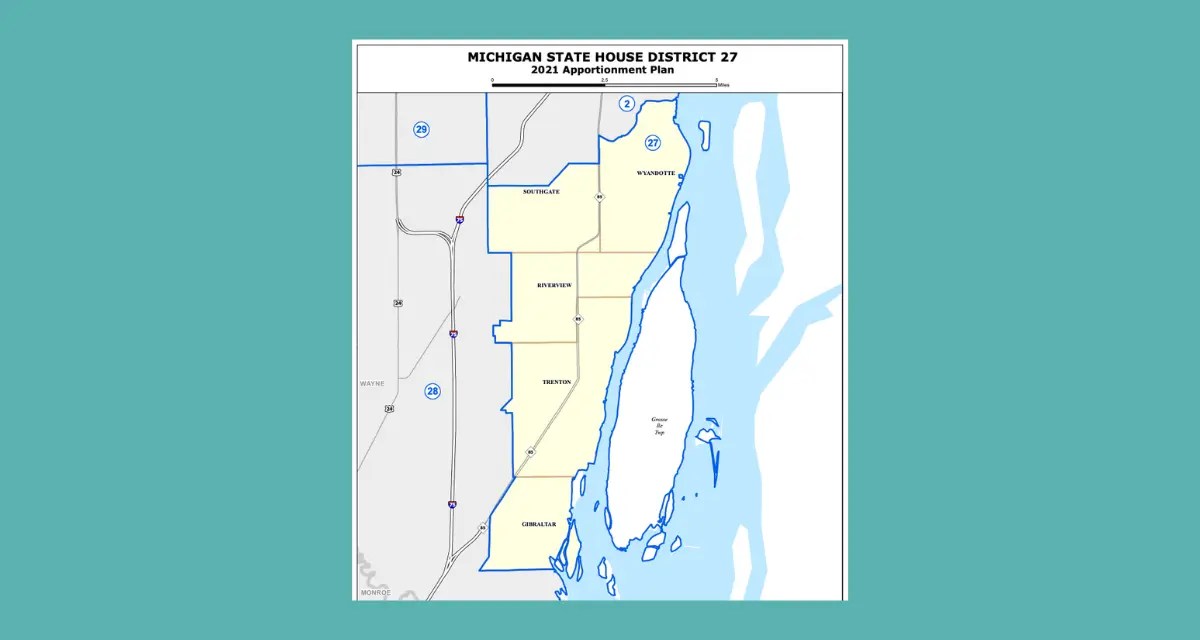
Michigan’s 27th House District covers a stretch of Wayne County along the Detroit River, including Grosse Ile Township, Gibraltar, Riverview, Trenton, Wyandotte, and a portion of Southgate. It’s home to roughly 89,000 people.
Churches held this seat for one term before Linting flipped it in 2024—by a margin of roughly 2,300 votes. Churches initially won the seat in 2022 by just 660 votes, making this district one of the most reliably competitive in the state. This rematch is shaping up to be just as close.
Rylee Linting (R)
Linting, a Grosse Ile resident and Wyandotte native, made history in 2024 by becoming the youngest member of the Michigan Legislature. She was 22 years old when she won.
Before taking office, Linting built her political career through conservative organizing—including as a Michigan Republican Party Youth Chair and a field representative for Turning Point Action, the political arm of Charlie Kirk’s youth conservative organization. She attended Grand Valley State University and Liberty University, where she says she “faced indoctrination, vaccination mandates, and woke student culture.” It’s unclear whether she ever made it to graduation.
Linting serves as vice chair on the state House Education and Workforce Committee and as a member of the Communications and Technology, Energy, and Regulatory Reform committees.
In her first term, she has focused heavily on property taxes and housing costs, authoring legislation to eliminate Michigan’s real estate transfer tax and championing a broader reform package that Republicans say would reduce average homeowner tax bills by roughly 14%.
Linting also helped secure state funding for a new fire engine for Riverview, a ladder truck for Wyandotte, and water main restoration in Southgate. And she authored a bipartisan bill—which was signed by the governor—to keep Michigan in the Interstate Medical Licensure Compact, ultimately preserving telehealth access and in-state licensure for thousands of physicians.
Despite some noteworthy bipartisan wins, Linting’s record raises real questions for voters who care about reproductive rights, environmental policy, and the role of money in politics.
She is endorsed by Right to Life of Michigan, an organization that supports abortion bans with no exceptions for rape or incest. Planned Parenthood has said she “will work to ban abortion.”
Linting also co-sponsored House Bill 5710, which would repeal Michigan’s landmark clean energy laws and lock the state into continued dependence on fossil fuels—a move that helped earn her a 0% score from the Michigan League of Conservation Voters. The League also notes she has accepted $3,000 in campaign donations from corporate utility companies while in office.
On immigration, Linting sponsored legislation that would bar people in the country without legal status from receiving social welfare grants and participating in other taxpayer-funded programs.
There’s also the matter of her dining habits. A recent report from Bridge Michigan found that Linting received nearly $6,000 in free meals from lobbyists in 2025—the sixth-highest total among all state lawmakers and executive branch officials. When reporters asked about the meals, Linting did not address them directly, instead pointing to her legislative record.
“The results speak for themselves,” she told the News-Herald.
Her website lists her top priorities as lower taxes, less government, and more freedom. Linting’s campaign webpage also encourages Michiganders to contact her directly at 734-258-7963.
Jaime Churches (D)
Churches, a Grosse Ile resident and longtime Downriver public school teacher, is making her second run for this seat after narrowly losing it to Linting in 2024. She served one term in the state House before that—from 2023 to 2024—in which she represented the same district.
Churches attended Woodhaven-Brownstown and Grosse Ile public schools before going on to earn a bachelor’s degree and a master’s degree in education from Madonna University. She has also served as the vice president of her local Michigan Education Association chapter.
Her first stint in the legislature was, by the numbers, a productive one.
As a state lawmaker, she helped secure $20 million for repairs to the Grosse Ile Free Bridge, $20 million for a railroad crossing in Trenton, $10 million for the Downriver Career Tech Consortium, $5 million for lead line replacements in Wyandotte and Gibraltar, and more.
She was also part of the Democratic caucus that passed clean energy laws, reinstated prevailing wage, repealed the pension tax on seniors, expanded the Earned Income Tax Credit, extended the Elliott-Larsen Civil Rights Act, and repealed the state’s 1931 abortion ban.
Planned Parenthood called Churches a “proven leader and sexual and reproductive health champion.” She also has a 100% score from the Michigan League of Conservation Voters.
On the campaign trail, Churches has been a vocal critic of the Trump administration’s aggressive immigration enforcement, including joining protests against a proposed immigration detention facility in Romulus. She has also pushed back on data center development, raising concerns about the potential impact on water and electricity rates for residential customers.
On her campaign website, Churches lists public education, healthcare access, environmental protection, and support for working families as her top priorities. More specifically, she’s calling for universal free pre-K, full-time literacy coaches in every elementary building, insurance coverage for in-vitro fertilization, and holding corporate polluters accountable for cleanup costs.
Churches’ website doesn’t list any 2026 endorsements but cites a wide array of support she received in 2024—including from Run for Something, the Michigan Equality Action Network, EMILY’s List, the Michigan Education Association, the UAW, and a host of other labor unions.
She encourages Michiganders to contact her directly at jaime@jaimechurches.com.
What’s at stake?
Control of the Michigan House of Representatives hangs on a handful of seats like this one.
Republicans hold a narrow majority there and Democrats need to flip some battleground districts if they want to regain the gavel in 2027. The 27th District is exactly the kind of race that will determine which party runs Lansing—and what gets done there—for the next two years.
Click here to make sure you’re registered to vote and to find your precinct. The only date that matters here: Nov. 3, 2026. Both candidates are running unopposed in the Aug. 4 primary.
READ MORE: How many AI data centers are planned in Michigan? We counted.
Don’t miss Michigan’s biggest stories—follow The ‘Gander on Instagram.