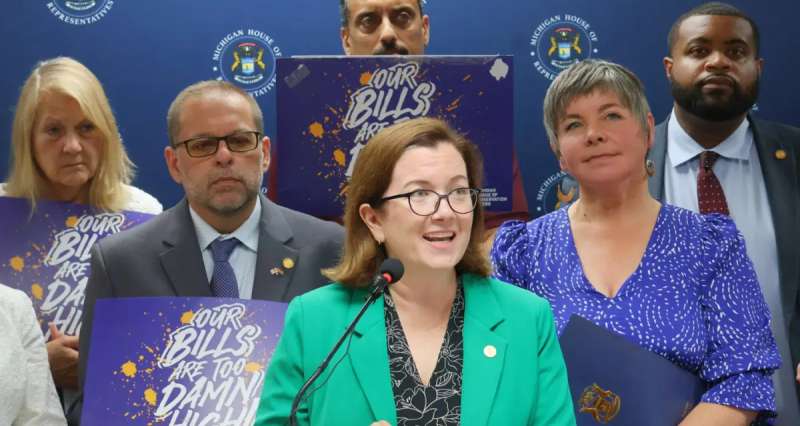
MICHIGAN—In their continued push for a Ratepayer Bill of Rights, Michigan House Democrats joined with environmental and consumer advocates Wednesday to unveil three additional pieces of legislation intended to provide greater scrutiny of Michigan’s energy companies.
Citing ongoing consumer frustration with poor energy reliability and high rates, Reps. Natalie Price (D-Berkley), Erin Byrnes (D-Dearborn) and Betsy Coffia (D-Traverse City) proposed policies to bar Michigan’s regulated utilities from using ratepayer funds to support executive compensation, political lobbying, advertising and political spending, cap the companies’ return on equity at 8.2% and require an independent audit every five years to examine utility performance.
The bills had not been assigned numbers as of Thursday morning, but were intended to pair with a host of proposed ratepayer protections introduced in the fall to ensure customers receive fair compensation for lengthy power outages.
DTE and Consumers Energy, the state’s largest energy companies, have drawn significant scrutiny in recent years, due to their annual requests to raise energy rates in the face of ratepayer frustrations with costs and reliability.
Michael King, the West Michigan regional organizer for the Michigan League of Conservation Voters, said that as a young Michigander on a limited budget, he’s felt the impact as energy bills continue to rise.
“Hundreds and thousands of families are being left with the choices between whether or not they should pay for food and put food on their family’s table, pay for the medicine in order to make their families healthy, or simply just keep their lights on,” King said, noting that while rising energy rates affect all residents, low-income families and communities of color are disproportionately impacted by rising costs.
The legislation proposed on Thursday will strengthen oversight of Michigan’s energy companies and ensure consumer dollars are used to strengthen the energy grid and improve reliability, King said.
Coffia also pointed to the Michiganders for Money Out of Politics ballot petition campaign as a blinking red light from Michigan residents that the current system around utility regulations is in need of repair.
The campaign recently filed 562,000 signatures with the Michigan Bureau of Elections to place a proposal on the November ballot to bar utility companies and government contractors from contributing to political campaigns.
DTE and Consumers Energy have opposed efforts to limit their political spending, emphasizing that their donations stem from their voluntary contributions from their employees and shareholder dollars, not ratepayer funds.
While the proposals shared Thursday are the latest in a number of bills introduced in response to rising energy rates, state Sen. Jim Runestad (R-White Lake) also put forth a proposal focused on limiting rate hikes.
Runestad’s Senate Bill 1031 would require utility companies to rely on actual costs when requesting a rate increase rather than future projections.
“By using actual data, utilities can fairly and accurately prepare for future energy needs in Michigan,” Runestad said in a statement. “If costs rise, they have a chance to demonstrate that. However, the endless cycle of rate increase after rate increase without any consideration for the consumer must end.”
While Consumers Energy is reviewing Runestad’s proposal, Katie Carey, the company’s director of media relations, argued that Thursday’s press conference was littered with inaccuracies, saying in a statement Consumers would “continue to work toward actionable policy solutions with pragmatic legislators who have taken the time to understand energy policy and Michigan campaign finance law.”
In an emailed statement, DTE spokesperson Ryan Lowry acknowledged consumer concerns about energy rates, telling Michigan Advance the company’s investments into its electric system have delivered improved reliability, and that it must continue investing in the grid to deliver the service that its customers demand.
The company reported a 60% reduction in outage time between 2024 and 2025.
READ MORE: Michigan Dems pitch new plan for free life-saving meds—including EpiPens
This coverage was republished from Michigan Advance pursuant to a Creative Commons license.