MICHIGAN—This year, hundreds of thousands of Michiganders were asked to sign petition drives seeking to change state laws or amend the state Constitution. Only one of those petitions gathered enough valid signatures and made it all the way through the certification process.
Paired with the question of whether Michigan should hold a Constitutional Convention, that means Michiganders will vote on two separate ballot proposals in November. The ballot became official in early September, after a pair of court rulings settled the last open question.
Here’s a quick guide to the two proposals:
Proposal 1 — Constitutional Convention
Michigan’s state Constitution includes a clear requirement that Michigan voters get asked once every 16 years whether or not they want to convene a new constitutional convention—also known as a Con-Con—that could lead to significant changes to the state Constitution.
Every time this question has hit the ballot, Michigan voters have said no—by enormous margins. This year will mark the fourth time Michiganders will vote on the issue.
If voters say yes, Michiganders would elect 148 delegates—one from each state House and Senate district—to open up and potentially revise portions (or all) of the state Constitution.
Everything, including the part that guarantees reproductive rights, would be on the table.
If this passes, the convention would start in 2027. There’d be no set agenda, no guardrails on what delegates can and can’t touch, and no set timeline for how long the process would take.
But here’s one important check: Whatever delegates come up with would still have to go back to voters for final approval before any proposed changes would be allowed to take effect.
The opposition has only gotten broader as Election Day approaches. A wide variety of Michigan groups—including the state Chamber of Commerce, the state AFL-CIO, the state Education Association, Business Leaders for Michigan, the League of Conservation Voters, and the League of Women Voters—are uniting to urge Michiganders to vote no on the proposal.
Earlier this month, former Democratic Congressman Dan Kildee and former Republican Attorney General Bill Schuette also appeared together to make the case against Proposal 1.
The Michigan Democratic Party has also come out against the measure, with leaders saying it could essentially roll back years of progress. Meanwhile, some state Republican leaders are backing the Con-Con, arguing the 1963 constitution is outdated and needs to be simplified.
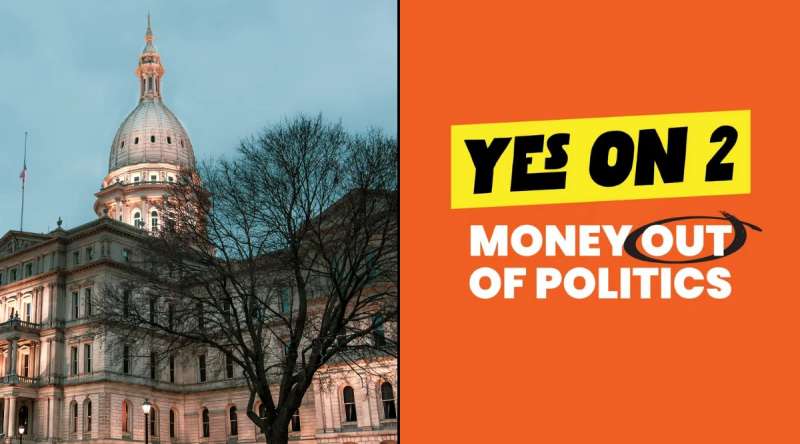
Proposal 2 — Michiganders for Money Out of Politics
Michiganders for Money Out of Politics, known as MOP Up Michigan, wants to bar political donations from the state’s regulated utility companies—like DTE and Consumers Energy—as well as other corporations with large state or local contracts that total over $250,000 a year.
The proposal also aims to add additional disclosure requirements for so-called “dark money” groups that often purchase advertisements focusing on candidates ahead of Election Day.
The group submitted 562,000 signatures in May to put the proposal on the ballot in November—about 200,000 more signatures than what was required. The Board of State Canvassers certified the signatures in July and signed off on the ballot language in August.
Under the state Constitution, lawmakers had 40 session days to enact the proposal outright instead of sending it to voters—and the Republican-led House voted 77-26 to do exactly that.
But Democrats in the state Senate declined to take it up, saying more than half a million signatures made clear that Michiganders wanted to decide this one themselves in November.
The distinction matters. A law enacted by the Legislature can be amended later by a simple majority. One approved by voters at the ballot box would take three-fourths of both chambers to change. MOP Up Michigan organizers backed the decision to send it to a statewide vote.
Supporters—like Clean Water Action State Director Sean McBrearty—say the measure will help Michiganders “take back their power” from utilities and government contractors who have “used their incredible wealth to purchase power in Lansing that rightly belongs to the people.”
Opponents have argued the proposal runs afoul of the First Amendment, even asking the Michigan Supreme Court to block it. So far, the proposal has survived those legal challenges.
That’s it?
Yep. There are plenty of important candidates running for state and federal offices in November. But Michiganders will only decide on two statewide proposals in this year’s general election.
The biggest near-miss was Americans for Citizen Voting, which sought to require voters to provide additional proof of citizenship to cast a ballot, among other changes. The group submitted more than 700,000 signatures, but the Board of State Canvassers deadlocked 2-2 in August after hours of picking through challenged signatures—and a tie meant no action, which left the measure off the ballot. Appeals to both the US and Michigan supreme courts were rejected on the same day in early September. Campaign officials plan to try again in 2028.
AxMiTax, a petition that sought to eliminate property taxes in Michigan, reportedly “fell just shy” of the 446,198 valid voter signatures needed to put the measure on the ballot. Another petition to shift Michigan’s elections to ranked choice voting was suspended in December.
Other petition drives—like Invest in MI Kids and Voters to Stop Pay Cuts—halted their signature collection efforts earlier this year and will also not appear on this year’s ballot.
Election Day is Nov. 3. Absentee ballots will start hitting mailboxes in late September.
READ MORE: Michiganders don’t need a constitutional convention to change state law
Don’t miss Michigan’s biggest stories—follow The ‘Gander on Instagram.