
MICHIGAN—Every seat in the Michigan House of Representatives is on the ballot this November. The ‘Gander is profiling the races that could decide who controls Lansing.
Here’s what voters need to know ahead of Election Day in the 28th House District:
The race
Republican state Rep. Jamie Thompson and Democratic challenger Sherry Berecz are running unopposed in the primary election. They’ll face off in the general election on Nov. 3.
The district
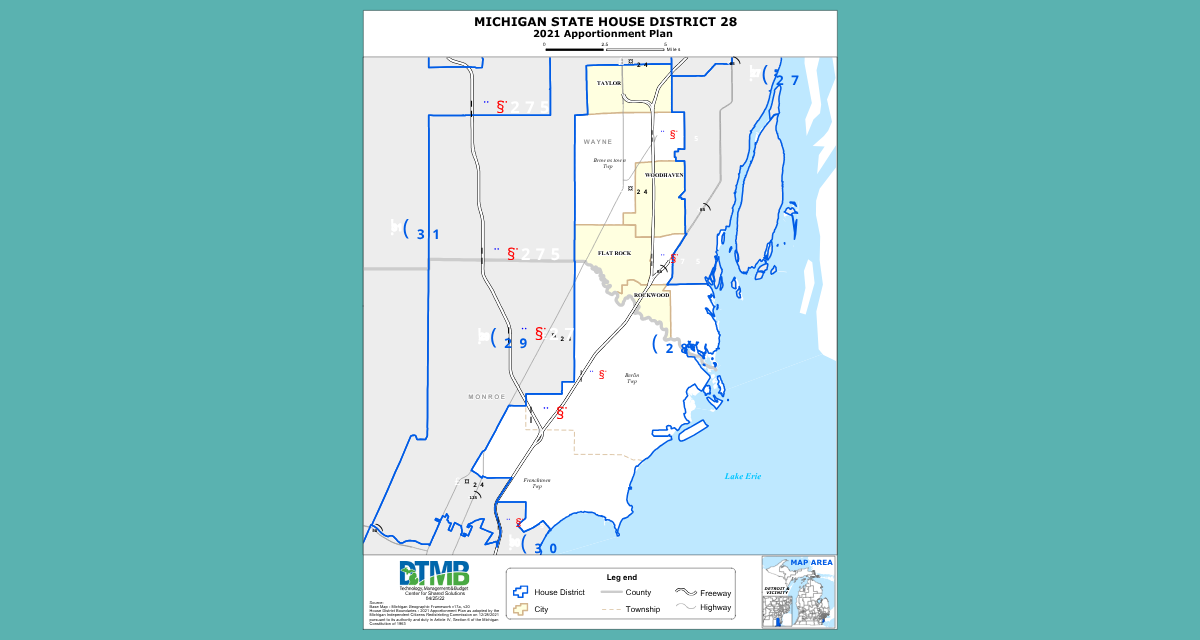
Michigan’s 28th House District sits along Lake Erie in Southeast Michigan. It includes Brownstown Township, Flat Rock, Rockwood, Woodhaven, parts of Taylor in Wayne County, as well as Berlin and Frenchtown townships in Monroe County. It’s home to roughly 90,000 people.
Thompson is in her second term. She was elected in 2022, defeating Democratic challenger Robert Kull by less than 800 votes. She won by a larger margin in 2024, beating Democratic challenger Janise Robinson by about 4,000 votes—with a final tally of about 54% to 46%.
Berecz will be the third Democrat to go up against Thompson. But she’s the first one to have three decades of elected experience in the district’s largest township on her resume.
And this district is complicated. In 2022, 57% of voters here approved a state constitutional amendment guaranteeing the right to reproductive freedom. That same year, those same voters elected Thompson even though she had publicly supported a near-total abortion ban.
That disconnect—paired with a razor-thin Republican majority in the state House—is exactly why both Democrats and Republicans will be pouring resources into the 28th District this fall.
Jamie Thompson (R)
Thompson, a Brownstown Township resident, is a licensed practical nurse who studied at Wayne County Community College and has worked in both acute and long-term care. She has also worked as a professional doula, supporting women through pregnancy and childbirth.
A self-described lifelong Christian and a member of the Mississaugas of Hiawatha First Nation, she has three children and is a legal guardian—along with her husband—to three of her four grandchildren, following the death of her 24-year-old daughter in 2021.
Now in her second term, Thompson serves as the vice chair of the state House Health Policy Committee and sits on the Energy, Families and Veterans, and Regulatory Reform committees.
Her healthcare background shows up in her legislative record. She recently authored a bill to add continuing education requirements for respiratory therapists, which passed the House with bipartisan support. She also sponsored bipartisan bills to expand menopause education for physicians, and penned a resolution to honor “Skilled Nursing Care Week” in Michigan.
Thompson has also fought to secure state funding for Downriver communities, including $1.5 million for a new truck for the Brownstown Fire Department, $700,000 for municipal water connections in Berlin Township, and lead line replacement funding for the city of Taylor.
But a deeper dive into Thompson’s record raises questions for voters who care about abortion rights, clean energy, immigration, election integrity, and the role of money in politics.
On reproductive rights, Thompson’s position is unambiguous. She told Right to Life of Michigan and the Alliance Defending Freedom—a Southern Poverty Law Center-designated anti-LGBTQ hate group—that she supports banning all abortions with no exceptions other than the life of the mother, including in cases of rape or incest. She also voted against every bill in the Reproductive Health Act and has publicly called for defunding Planned Parenthood.
On the environment, Thompson voted to repeal Michigan’s landmark clean energy laws—a move that helped earn her a dismal 14% score from the Michigan League of Conservation Voters. The League also notes she has accepted $4,500 in campaign donations from corporate utility companies since taking office, including $2,500 so far this legislative session.
Union households may also want to take note: In 2023, Thompson opposed the repeal of Michigan’s so-called “right-to-work” laws, which had weakened unions for over a decade by letting workers benefit from collective bargaining without being required to pay union dues.
On immigration, Thompson sponsored legislation to bar people without legal status from receiving social welfare services and housing assistance—part of a Republican package that also sought to ban so-called “sanctuary” policies statewide. Thompson has also repeatedly attacked the state’s Newcomer Rental Subsidy program, claiming it offers “rent assistance to illegal aliens who get arrested and then claim asylum to avoid deportation”—a characterization that misrepresents the program, which serves refugees and other lawful immigrants in Michigan.
During her first campaign in 2022, Thompson joined a chorus of election deniers in voicing support for a so-called “forensic audit” of the 2020 presidential election. Her husband, Ronald Matte, also served as president of the Michigan Leadership Group, an organization that raffled off an AR-15 at a fundraiser just weeks after the school massacre in Uvalde, Texas.
There’s also the matter of how Thompson spends her donors’ money. A Detroit News investigation published in February found that her campaign paid her son more than $24,000 in consulting and canvassing fees between August 2024 and December 2025—about 15% of its total spending—including payments made after he was charged with domestic violence.
Thompson’s top campaign donors reportedly include the Michigan Oil and Gas Association, the Small Business Association of Michigan, and the Monroe County Republican Party. Her endorsements include the Michigan Freedom Fund and the Great Lakes Education Project—the school choice advocacy group founded by the billionaire Betsy DeVos and her family.
Her campaign website lists her top priorities as easing inflation, school choice, public safety, and government transparency. Thompson also encourages residents to contact her office via email.
Sherry Berecz (D)
Berecz is a lifelong Downriver resident, a mother of three, and arguably the most experienced local official to challenge Thompson for her seat. She currently serves as Brownstown Township Supervisor, capping more than 25 years in township government as a clerk and trustee.
Public service runs in the family: Her father served as Brownstown’s longtime treasurer, and Berecz says she was six years old when she first learned that public service meant “showing up, listening to neighbors, and fighting for the community you love.”
Before and alongside her township work, Berecz spent more than 20 years working for Wayne County, including in the Department of Children and Family Services and its alternative workforce program, which helps put non-violent offenders to work on county projects.
She has an English degree from Madonna University and returned to school in 2019 to earn a master’s degree in public administration from Central Michigan University.
Berecz comes from a union household. She’s a former member of the Government Administrators Association and the mother of union members—and her campaign leans on that identity, pledging to defend collective bargaining and “the dignity of good-paying work.”
“Sherry is running to give Monroe and Downriver families a strong voice in Lansing—someone who understands the community, knows how local government works, and will fight to lower costs, protect workers, and build an economy that works for everyone,” her website states.
So far, her platform is longer on biography than policy. Her campaign website promises lower costs, jobs, and infrastructure investment but doesn’t yet detail specific legislative proposals.
Berecz has been endorsed by EMILY’s List and the Michigan AFL-CIO.
What’s at stake?
Control of the Michigan House of Representatives hangs on a handful of seats like this one.
Republicans hold a narrow majority there and Democrats need to flip some battleground districts if they want to regain the gavel in 2027. The 28th District is exactly the kind of race that will determine which party runs Lansing—and what gets done there—for the next two years.
Click here to make sure you’re registered to vote and to find your precinct. The only date that matters here: Nov. 3, 2026. Both candidates are running unopposed in the Aug. 4 primary.
READ MORE: How many AI data centers are planned in Michigan? We counted.
Don’t miss Michigan’s biggest stories—follow The ‘Gander on Instagram.