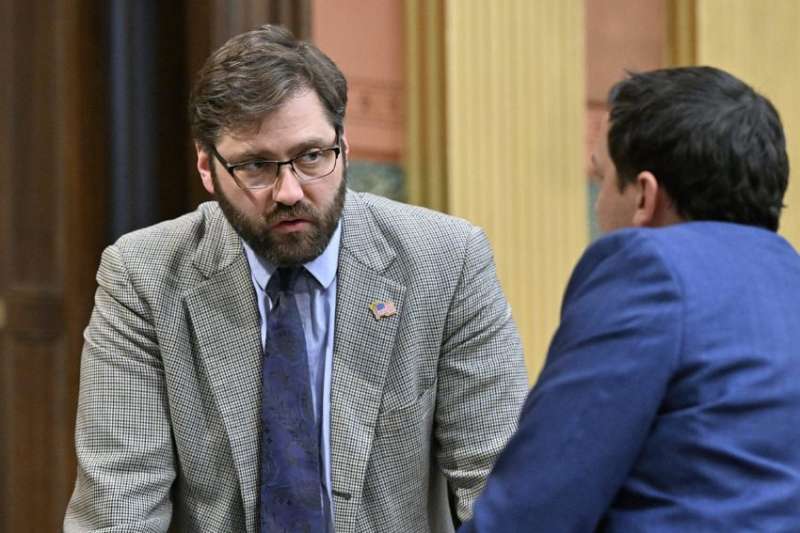
Voters will decide in November who gets to serve on the most powerful court in Michigan. And Republican state Rep. Andrew Fink thinks he deserves a spot on the bench.
MICHIGAN—Andrew Fink, a two-term Republican state lawmaker, is running this year for one of two open seats on the Michigan Supreme Court. His Democratic-backed opponent is Kimberly Ann Thomas, an attorney and professor at the University of Michigan School of Law.
Democratic-backed justices currently hold a 4-3 majority on the Court. Republican victories could flip control of the Court, while two Democratic wins would yield a 5-2 Democratic majority.
Despite the clear political party affiliations of the four candidates, this race appears in the non-partisan section of the ballot. Absentee voting is already underway. Election Day is Nov. 5.
Who is Andrew Fink?
Fink, of Adams Township, opted against running for a third term in the state House of Representatives this year to instead pursue a Republican bid for the Michigan Supreme Court.
During a candidate forum at a church in rural Livingston County this summer, Fink introduced himself as a “constitutional conservative,” who would take a hardline, textualist view of both state laws and the Michigan Constitution. That commitment is also echoed on his campaign website, where Fink pledges to “apply an unwavering originalist interpretation to every case.”
Aside from the candidate forum and two recent interviews, Fink has kept a relatively low profile ahead of Election Day. He skipped a second virtual candidate forum last month, which had included an opportunity for all four candidates to field questions from the media, and his campaign hasn’t responded to The ‘Gander’s request for an interview ahead of Election Day.
But Fink’s “originalist” approach to the law—as well as his voting record during his time in the state Legislature—may reveal how he would make key decisions, if he’s elected to the Court.
Here are five things to know:
1.) Fink’s textualist views are raising concerns.
During the recent church forum, Fink was asked about how he would go about making decisions, if he were elected to the state’s top court. And his answers have been consistent.
“The role of a judge is to say what the law is according to the original meaning of the text, not what it should be,” according to Fink’s campaign website, which also bills him as “the best candidate to bring this originalist jurisprudence to the Michigan Supreme Court.”
Originalism, which can also be described as textualism or constitutional conservatism, is a philosophy that guides how judges can interpret laws and make other decisions in the courtroom. At its core, it asserts that laws should only be interpreted according to the plain meaning of the text—and not the actual intent of those who wrote or passed them into law.
In an exclusive interview with The ‘Gander, Michigan ACLU Legal Director Bonsitu Kitaba said Michigan voters should be “very careful” with the concept of textualism this year—especially given the damage that particular judicial philosophy could have on their civil liberties.
“I think what [Republican-backed judges] are trying to telegraph, especially when they couple those phrases with conservatism, is they want to take a narrow view of what the Constitution means and what civil rights mean to people,” she said. “Voters have to be very careful when they’re assessing the credentials and philosophies of these judges when they say that.”
And it’s not just a theory. Originalism is the exact principle that guided the majority on the US Supreme Court that overturned Roe v. Wade and peeled back the constitutional right to abortion for millions of women. And in other states with more conservative state Supreme Courts, abortion rights have been steadily chipped away since the US Supreme Court overturned Roe.
2.) Fink’s voting record speaks for itself.
Fink’s voting record is littered with bills that target reproductive freedom and civil rights.
During his time in the Legislature, Fink sponsored legislation to ban abortion after fetal viability, as well as a bill that would have reportedly created a legal loophole in the state’s newly expanded civil rights laws—namely by allowing for discrimination against LGBTQ people, just as long as that discrimination aligned with the practice of a religion. Both bills failed to advance.
Of course, Michigan’s Code of Judicial Conduct now requires that Fink—and all other judicial candidates—keep quiet on those controversial issues, so as to avoid “impropriety and the appearance of impropriety” and not to appear biased on high-stakes issues like abortion.
But groups dedicated to protecting Michiganders’ rights, including their ability to make their own reproductive health care decisions, clearly haven’t forgotten about Fink’s record on the issue.
“We’ve seen time and again that state courts are on the front lines of our fight for reproductive freedom. Michiganders need justices they can trust to uphold their rights,” Reproductive Freedom for All President Mini Timmaraju said in a statement endorsing Thomas.
3.) Fink has a history of questioning the 2020 election results
During his first few weeks in office, Fink repeatedly called into question the outcome of the 2020 presidential election—including by echoing ex-President Donald Trump’s false allegations that the election included “outright fraud to terrible mistakes that must be corrected” in posts on his Facebook page, and encouraging Trump supporters to “stay vigilant, and stay the course.”
As a lawmaker, Fink voted against several bills that were designed to make it easier for Michiganders to vote and to expand voter registration, as well as to criminalize poll worker intimidation and regulate the use of artificial intelligence in political ads. Fink also opposed a bill to tighten up the election certification process that Trump tried to disrupt after his 2020 loss.
Additionally, Fink is a card-carrying member of the Federalist Society, a right-wing legal network that has reportedly adopted a wide range of election-related conspiracy theories and whose members have publicly promoted false statements about a “stolen” election in 2020.
He also reportedly worked as a district director for former state Senate Majority Leader Mike Shirkey, who falsely claimed that the Jan. 6 attack on the US Capitol was staged.
After Fink skipped a Q&A at a virtual candidate forum this summer, The ‘Gander followed up with his campaign to ask whether Fink would commit to accepting the results of this year’s election regardless of whether or not he wins. That email has not received a response.
4.) Fink has been endorsed by far-right figures and groups.
Because the seven judges who serve on the Michigan Supreme Court are technically nonpartisan, and often guarded about their political views, it’s not always easy for voters to identify which judicial candidates align most closely with their personal beliefs and values.
Campaign endorsements, however, can offer key clues—and may offer some insight into how Fink could interpret the state Constitution and state laws if he’s elected to the bench.
For starters: Fink’s campaign is backed by a nomination from the Michigan Republican Party—which is generally opposed to reproductive rights, gun safety reforms, and minimum wage increases. Many Michigan Republicans have also denied valid election results.
Right to Life of Michigan, a staunch, anti-abortion organization with a history of advocating for state legislation to restrict reproductive rights in Michigan, is backing Fink this year.
Other groups backing Fink include: the National Federation of Independent Business (NFIB), a lobbyist group with clear ties to right-wing political movements and anti-worker policies, as well as political action committees that represent the Michigan Chamber, which tends to lobby in support of issues that favor business interests over those of workers and their families.
A long list of other ultra-conservative Republican politicians are also listed under Fink’s endorsements—including several sponsors of state-level anti-abortion and anti-LGBTQ bills, as well as several state lawmakers who have been identified as election deniers in a recent report.
That includes Republican state Rep. Angela Rigas, who attended the insurrection in Washington D.C. on Jan. 6, 2021, as well as US Congressman Tim Walberg, who has voiced support for laws that sentence people to death for being part of the LGBTQ community.
Citizens for Traditional Values as well as the Conservative Political Action Conference (CPAC) have also endorsed Fink. Both groups have a long reputation of opposing reproductive rights, protections for the LGBTQ community, and pro-union policies that benefit Michigan workers.
5.) Fink admires US Supreme Court Justice Clarence Thomas.
During the Republican candidate forum this summer, Fink said that he personally admires US Supreme Court Justice Clarence Thomas, who, in addition to facing a corruption scandal, generally opposes constitutional protections for abortion and LGBTQ rights.
“I twice got to hear from Justice Thomas, got to meet him at Hillsdale,” Fink told a small crowd at the church. “And both his life story and the fact that his mission as a justice is to write an accurate, constitutional history of the United States, make me say Justice Thomas, every time.”
READ MORE: Republican candidates go full MAGA at Michigan Supreme Court debate
For the latest Michigan news, follow The ‘Gander on Twitter.
Follow Political Correspondent Kyle Kaminski here.