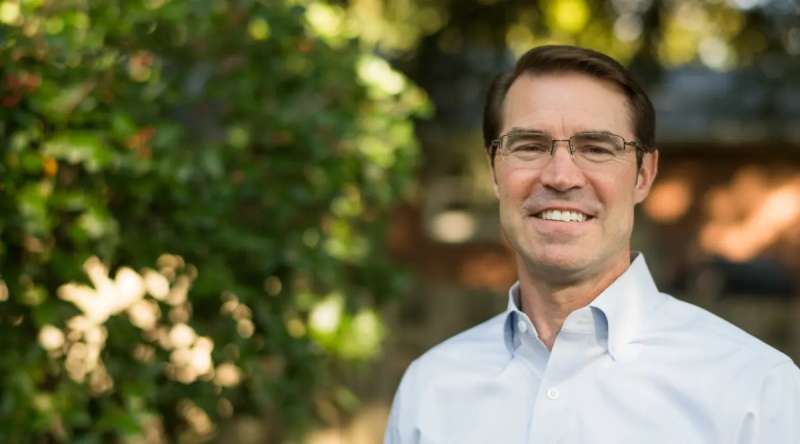
MICHIGAN—Sean McCann, the Democratic state senator running for Congress in Michigan’s 4th District, is out with a new 10-point plan to stop lawmakers from getting rich in office.
And he’s aiming it squarely at the Republican he’s trying to unseat in this year’s election.
McCann’s proposal—which was shared first with The ‘Gander—would ban members of Congress from trading stocks, bar them from becoming lobbyists, and tighten the rules on the kind of campaign spending that McCann says US Rep. Bill Huizenga (R-Holland) has exploited.
“Everywhere I go across this district I hear from people who feel like they are working so hard but can’t get ahead, and at the same time they’re watching Washington politicians ignoring the people to get rich instead,” McCann said in a statement announcing his plan this week. “We’ve got a corruption problem in this country and it’s time to hold the powerful accountable.”
What’s in the plan?
McCann’s new plan includes 10 specific items for his congressional to-do list—several of which track closely to questions that have been raised about Huizenga’s own conduct in Congress.
Specifically, McCann would:
- Ban stock trading by members of Congress, their spouses, and their children, requiring them to divest existing holdings.
- Bar members of Congress and their staff from betting on prediction markets.
- Pass a constitutional amendment overturning Citizens United.
- Ban members of Congress from becoming lobbyists after leaving office.
- Empower the Federal Election Commission to regularly audit campaign spending.
- Bar members of Congress from using taxpayer money for first-class flights, private jets, or above-market lodging.
- Strengthen the Office of Congressional Conduct, which investigates ethics complaints.
- Institute a code of ethics for the US Supreme Court.
- Ban members of Congress from putting family members on their office payroll.
- Require mandatory prison time for elected officials who steal or misuse public funds.
Didn’t Congress just try this?
The first item on McCann’s list is similar to a measure the US House took up in July.
The Stop Insider Trading Act—which passed on a mostly party-line, 232-198 vote—would bar members of Congress, their spouses, and their dependent children from buying any new stocks, but allow them to keep and sell the shares they already own. Republicans also attached an unrelated voter ID requirement and exempted the president from the ban, which cost the bill most of its Democratic support and left its Senate prospects uncertain. Huizenga voted for it.
Huizenga’s record on the issue is mixed, though. In 2019 he was one of 13 members of Congress to oppose the Insider Trading Prohibition Act, which ended up passing the House 410-13 before dying in the Senate.
McCann’s plan would take those rules a step further, with a provision that would require full divestiture—meaning members of Congress, their spouses, and their children would all have to sell their individual stock holdings, not simply stop buying more during their time in office.
Huizenga’s record
Huizenga has been the subject of reporting on nearly every practice McCann’s plan targets.
End Citizens United named Huizenga to its 2026 list of the most corrupt politicians in Congress—the only Michigan lawmaker on it. The group points to his seat on the House Financial Services Committee, which writes the rules governing Wall Street, and to the corporate and PAC money that makes up a significant share of his fundraising.
Huizenga’s personal finances have also grown substantially during his tenure.
The Michigan Independent reports that Huizenga’s wealth has increased by as much as five-fold while in Congress. He also voted for the One Big Beautiful Bill Act, the Republican tax package that reportedly delivered as much as $50,000 in direct personal tax benefits to Huizenga.
But the overlap between Huizenga’s campaign and his family has drawn the most scrutiny.
The Detroit Metro Times reports that his campaign paid roughly $400,000 to a business owned by his brother and that Huizenga accepted donations from a company and its executives after one of his own businesses reached an agreement to lease property to that company.
His travel has drawn complaints as well. The Detroit News reported in 2019 that a review flagged concerns about tens of thousands of dollars in campaign funds Huizenga had spent on trips—including to Disney World. Huizenga’s office also confirmed to reporters earlier this year that he traveled with a delegation to Scotland during a partial government shutdown.
It’s worth noting: Huizenga is also the only member of Michigan’s congressional delegation who specifically declines to request federal earmarks for projects in his district—money other members have directed toward infrastructure, hospitals, and community programs back home.
McCann has already pursued a version of the plan’s third item in Lansing. In July, he and state Rep. Betsy Coffia (D-Traverse City) introduced joint resolutions modeled after a Montana initiative that would amend Michigan’s constitution to formally limit corporate spending in state-level elections.
The race
Huizenga has been in Congress since 2011 and has represented the 4th District since 2023. He defeated former Holland Mayor Philip Tanis with about 85% of the vote in the August primary election; McCann won his primary election with roughly 66% of the vote against Diop Harris.
McCann, who is term-limited out of the state Senate, has served in Lansing since 2011—first in the state House, then the Senate. He also spent a decade on the Kalamazoo City Commission.
The Cook Political Report rates the seat as lean Republican. Election Day is Nov. 3.
READ MORE: Huizenga-supported Big Beautiful Bill helps him, harms Michiganders
Don’t miss Michigan’s biggest stories—follow The ‘Gander on Instagram.