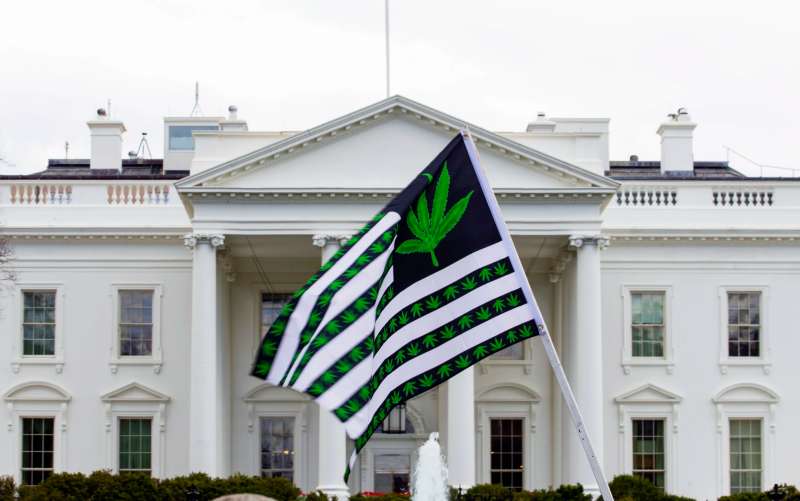
President Biden has issued expanded pardons for those convicted of simple cannabis possession, attempted simple cannabis possession, or cannabis use on federal lands and in Washington D.C., the White House announced last month.
Biden also granted clemency to 11 people serving what the White House called “disproportionately long” sentences for nonviolent drug offenses.
The president’s actions will not release any federal prisoners, but will lift barriers to housing, employment, and educational opportunities for those convicted of the offenses.
“Criminal records for marijuana use and possession have imposed needless barriers to employment, housing, and educational opportunities,” Biden said in a statement in December. “Too many lives have been upended because of our failed approach to marijuana. It’s time that we right these wrongs.”
According to NORML, a nonprofit organization that advocates for the reform of marijuana laws in the United States, African Americans are arrested for violating marijuana possession laws at nearly four times the rates of white people, “yet both ethnicities consume marijuana at roughly the same rates.”
This action by the president is just the latest round of executive clemencies meant to rectify racial disparities in the criminal justice system.
Biden issued a similar round of pardons in Oct. 2022. The new orders expand the grounds on which the initial pardons were issued. The first round, for example, pardoned people for simple possession under one criminal statute, but this latest round pardons people under several other criminal statutes, including attempted simple possession.
Biden’s proclamation effectively covers the pardoned people, but they will need to submit applications to the Justice Department’s pardon attorney office in order to receive certificates that will allow them to look for housing and employment opportunities.
Biden has also called on state lawmakers to take similar steps regarding marijuana convictions.
“Just as no one should be in a federal prison solely due to the use or possession of marijuana, no one should be in a local jail or state prison for that reason, either,” he said in his statement.
The president also announced that his administration will continue to review clemency petitions and “deliver reforms that advance equal justice, address racial disparities, strengthen public safety, and enhance the wellbeing of all Americans.”
Biden’s efforts come as states across the country legalize recreational marijuana and as the federal government weighs whether or not to reschedule cannabis under the Controlled Substances Act (CSA), a move that would loosen restrictions that come with Schedule I status, but wouldn’t legalize the plant federally.
Schedule I drugs (which include heroin and LSD) are deemed to have a high likelihood of abuse and no medical use, while Schedule III drugs (like ketamine) are described as having “moderate to low potential for physical and psychological dependence.”
If ultimately reclassified to a Schedule III drug, cannabis research and development would become easier, and marijuana-related businesses would also benefit, as it would help them access tax deductions and boost their ability to access loans, making it cheaper for them to operate.
In a statement, Melanie Campbell, president and CEO of the National Coalition on Black Civic Participation and Convener of The Black Women’s Roundtable called Biden’s latest action “far-reaching” and “compassionate.”
“The decision to pardon individuals convicted of simple marijuana possession is a critical step towards correcting the historical injustices perpetuated by our criminal justice system against communities of color,” she said.
The US Cannabis Council (USCC) also lauded the expanded pardons.
“The Biden administration is well on its way toward delivering the most impactful cannabis reform in history,” the council stated on Twitter. “We applaud President Biden for his ongoing commitment to reforming cannabis laws and addressing the harms of our nation’s failed drug war.”