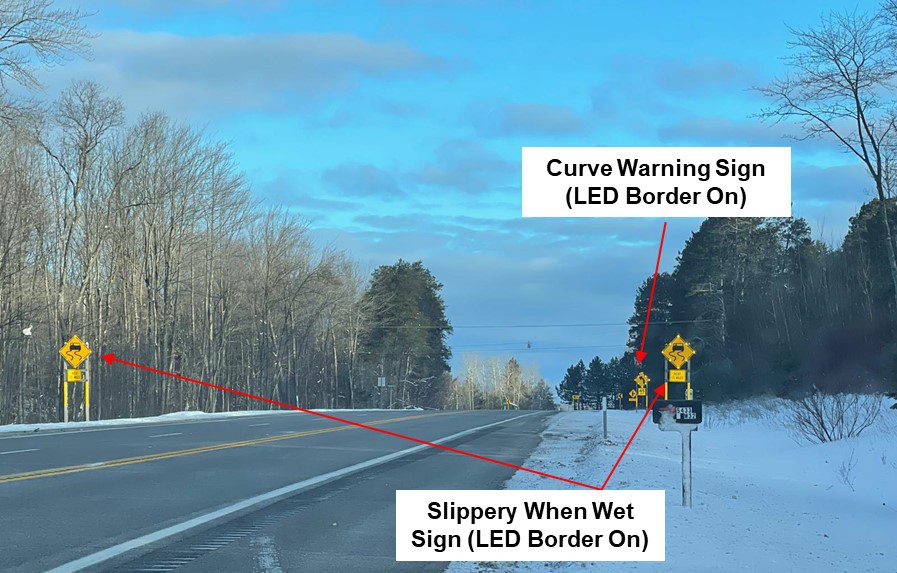
Example of activated slippery curve warning system signs on westbound M-32 near Gaylord. (Michigan State University)
By Eric Freedman, Capital News Service
LANSING—Winter—skid season—is almost upon us, making curves slipperier and more dangerous.
Now a new study done in Northern Michigan shows that flashing LED lights on signs near curves can successfully warn drivers to slow down during wintry conditions.
Curves can be deadly.
The state tallied 128,517 crashes on curved roadways during winter weather conditions between 2018 and 2022, causing 175 serious injuries and fatalities, plus 1,360 less serious and suspected injuries, the study said.
Curves on flat roads—called horizontal curves by highway engineers—“present a major challenge to drivers, especially when there is a significant difference between the posted speed limit and the curve advisory speed.”
Navigating curves becomes more hazardous when snow and ice reduce pavement friction, increasing the odds of a vehicle leaving its lane.
Horizontal curves are responsible for more than 25% of fatal crashes, and vehicles leave the road in most of those incidents.
Field testing of flashing LED lights took place along a 1.7-mile rural section of M-32 west of Gaylord. The two-lane undivided highway there has a posted 55 mph speed limit, while the curve has a 45 mph advisory speed.
The slippery curves study is part of a larger project looking for effective speed warning technologies, said Timothy Gates, a professor of civil and environmental engineering at Michigan State University. The research is funded by the Michigan Department of Transportation.
MSU researchers used sensors to collect data on pavement conditions and tested on days with early morning snowfall that tapered to overcast or light snow by midmorning, the study said. Air temperatures ranged from the upper 20s to lower 30s.
LED lights on the borders of “slippery when wet” and “curve” signs were programmed to automatically activate in 30-minute cycles during adverse conditions.
The signs “had a significant speed reduction effect for drivers approaching the curve during winter weather conditions,” according to the study published in the journal Transportation Research Record.
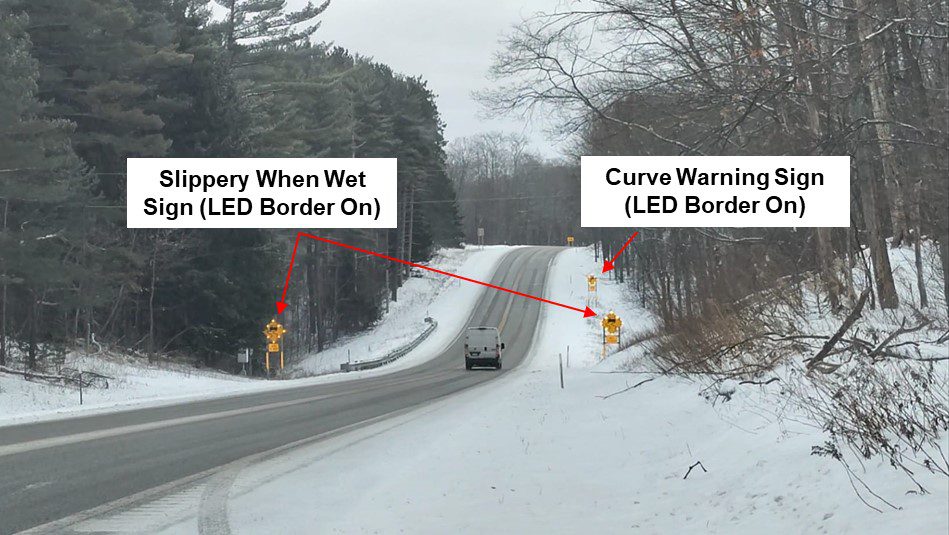
Example of activated slippery curve warning signs on eastbound M-32 near Gaylord. (Michigan State University)
Eastbound drivers slowed by an average of 1.5 mph, while the average speed of westbound drivers dropped by 0.9 mph on average when the LED lights were flashing, compared to when the lights were off.
The slowdown was more dramatic among the fastest one-third of drivers: a 1.7 mph average slowdown, the study said.
“The result is encouraging from a highway safety standpoint as the fastest drivers are most in need of speed reduction to safely traverse the curve during slippery conditions,” it said.
Gates, who coauthored the study, said “clearly measurable” gradual slowing in response to the flashing lights is important.
“Are we grabbing motorists’ attention that it might be slippery?” Gates said. “Especially in winter, you don’t want to see extreme deceleration. You don’t want people slamming on the brakes and losing control.”
The research illustrates how measures can be implemented to reduce accidents in advance rather than waiting until after people are injured or killed, he said.
Garrett Dawe, MDOT’s engineer of traffic and safety, said, “Our instincts were correct” and called the findings “validation of another potential tool in the toolbox we can use in traffic safety.”
Dawe said the sensor and flashing light technology is rather expensive and the department has no plans for its “mass deployment.”
“You have to pick the right locations,” he said, and installing that technology is being
reserved “for truly problematic” locations or where a safety problem needs to be addressed.
Meanwhile, MDOT is taking other steps to improve safety at curves.
They include coating pavement with a durable skid-resistant surface so “if someone is coming in too fast on a wet road, it may keep them under control,” he said. Another measure is adding reflective strips to warning signs at curves.
Gates said an upcoming project will research traffic control device technologies that can be implemented where rural highways come into small towns. It will look at traffic-calming measures that may be used in zones near schools, crosswalks and where pedestrians and bicyclists are active.
Author


Michigan is last state without a septic system code. Will that change?
By Justin Fox Clausen, Capital News Service LANSING—A new Senate bill would address the regulation, inspection and re-evaluation of septic systems....
Will Michigan get a north-south passenger train line? Where the idea stands
A nonprofit working on a long-term plan to create a passenger rail line that would run from Petoskey to Detroit is seeking additional public input...

Upper Peninsula communities join forces to push back against Big Tech
From Keweenaw to Sault Ste. Marie, communities across the Upper Peninsula are working together as AI data centers and bitcoin mining operations...

Michigan’s pothole predicament: waging war against the weather
By Clara Lincolnhol, Capital News Service LANSING — Michigan is anecdotally famous, or some might say infamous, for the poor quality of its roads....

New passenger train route between Holland and Detroit to be explored
LANSING – The Michigan Department of Transportation is developing a plan to potentially construct the state’s fourth passenger rail route. The...