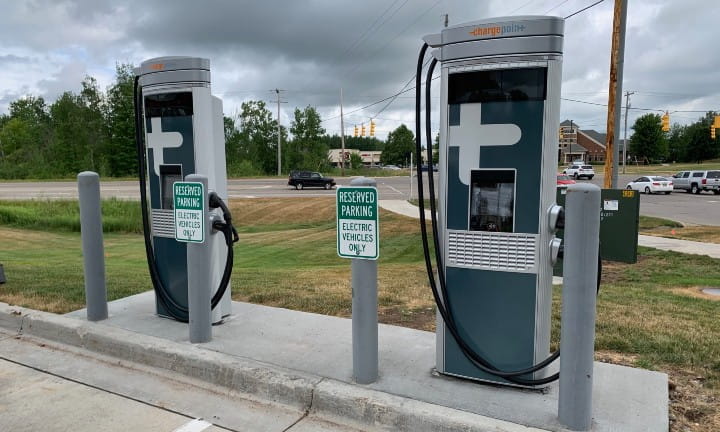
Electric vehicle chargers. (Department of Transportation)
By Bauyrzhan Zhaxylykov, Capital News Service
LANSING—Only about 5% of rural Michigan residents say they would choose an electric vehicle as their next car, according to a University of Michigan survey of more than 1,000 residents in rural ZIP codes statewide.
The findings come as Michigan works to expand electric vehicle use under its climate and clean energy goals, while rural communities continue to face challenges related to cost, charging access and long driving distances.
Researchers say some of those barriers are real, but others stem from misinformation.
That misinformation is especially common about home charging.
“There are so many people I talk to who say the same thing, like, ‘Oh, I can’t charge overnight,’” said Sabina Tomkins, an assistant professor of information at U-M and one of the study’s authors.
“I don’t really know where that information comes from. I think a lot of the time people just have this belief without checking it,” Tomkins said.
Survey data suggests those concerns are often overstated.
The study found that about 42% of respondents believed they could not charge a battery-equipped electric vehicle overnight at home.
However, researchers estimated that about 75% of those surveyed could meet their daily driving needs with a Level 2 home charger, even during winter.
Many respondents said they drive “too much in a day” for an electric vehicle, but a review of the data suggested otherwise.
Beyond charging logistics, the study found that some rural residents also worry about the environmental impact of lithium batteries used in electric vehicles, including mining and disposal.
Researchers say those concerns reflect a strong connection to the environment in rural communities.
“I think people in rural areas love nature,” said Anna Stefanopoulou, a U-M professor of mechanical engineering and a co-author of the study. “I totally understand their concerns about the disposal of lithium batteries.”
“But efforts to improve recycling can reduce those impacts, similar to what has happened with lead-acid batteries,” Stefanopoulou said.
While home charging may be more feasible than many people believe, access to public charging stations remains a major barrier.
About 70% of rural respondents did not have access to a fast charger within 5 miles at places where they would realistically stop, according to the study.
Although public chargers are available, researchers found they are often not located where rural drivers actually need them.
“There’s just not enough public charging infrastructure in rural areas,” Tomkins said.
“We found there’s some potential for information efforts around overnight charging, but there’s also a real need for infrastructure and policy spending focused on public charging,” she said.
National data shows these challenges extend beyond Michigan.
For example, a 2025 Mintel report found that affordability, range anxiety and uneven charging access continue to slow electric vehicle adoption across the U.S.
While about 12% of consumers nationally own an electric vehicle, ownership remains lower in the Midwest, where just 8% report owning an EV, compared with 16% in the West and 15% in the Northeast.
Parth Vaishnav, an assistant professor of sustainable systems at U-M and another co-author of the study, said infrastructure gaps play a major role in shaping rural adoption.
Without reliable public charging, Vaishnav said, electric vehicles remain less practical for many rural drivers.
In response to these barriers, in 2023, Gretchen Whitmer’s administration announced initiatives to accelerate use of electric vehicles across Michigan.
That included the launch of the State of Michigan Community EV Toolkit, which helps local governments plan for and expand EV charging infrastructure.
Backed by millions of dollars in state and federal investment, the state is working to build charging corridors with stations spaced roughly every 50 miles along major routes, while also supporting community-level chargers and clean energy manufacturing.
Beyond infrastructure gaps, the study also found that cost perceptions don’t always reflect reality. More than half of respondents who felt that electric vehicles are too expensive reported having household budgets showing they could afford an EV, indicating that many residents think they cost more than they actually do.
Fear of battery replacement costs also remains common.
Stefanopoulou said, “Concerns about the cost of replacing batteries are a bit strange since most EV manufacturers cover battery pack replacement under warranty.”
She noted that manufacturers must guarantee at least 80% battery capacity for 10 years or 150,000 miles, meaning batteries that fall below that level are usually replaced under warranty.
The authors said policymakers have already taken steps to address battery durability concerns, including a requirement that automakers display battery state-of-health information on vehicle dashboards beginning with 2026 models, a move they say could help reassure consumers.
Author


Upper Peninsula communities join forces to push back against Big Tech
From Keweenaw to Sault Ste. Marie, communities across the Upper Peninsula are working together as AI data centers and bitcoin mining operations...

Michigan’s pothole predicament: waging war against the weather
By Clara Lincolnhol, Capital News Service LANSING — Michigan is anecdotally famous, or some might say infamous, for the poor quality of its roads....

New passenger train route between Holland and Detroit to be explored
LANSING – The Michigan Department of Transportation is developing a plan to potentially construct the state’s fourth passenger rail route. The...

Ann Arbor residents plan ballot initiative to dump DTE and shift city toward public power
BY KYLE DAVIDSON, MICHIGAN ADVANCE MICHIGAN—A group of Ann Arbor residents are taking the first steps toward removing DTE Energy as their electrical...

Scholten leads Michigan Dems calling on Trump administration to restore solar energy funding
BY KYLE DAVIDSON, MICHIGAN ADVANCE MICHIGAN—Following the Environmental Protection Agency’s decision to cancel funding for the federal Solar For All...