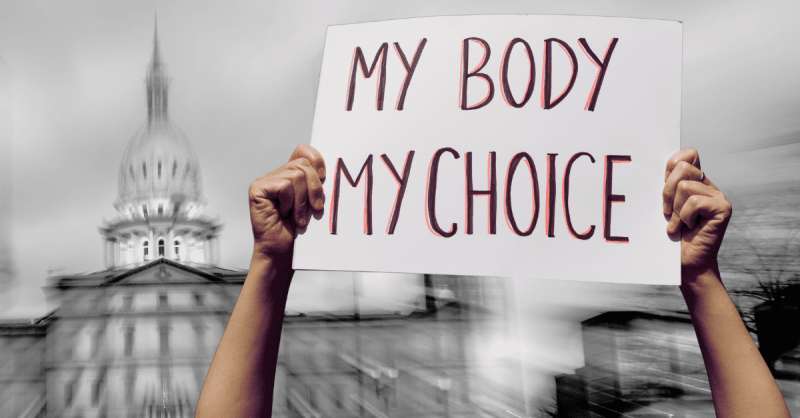
Reproductive rights advocates are suing the state to overturn regulations on abortion—including a law that forces all patients to wait 24 hours before they can receive care.
MICHIGAN—Michiganders took decisive action when they voted to enshrine the right to reproductive freedom into the state Constitution in 2022. But according to a lawsuit filed against the state this month, there’s still more work to be done to ensure meaningful access to care.
The Center for Reproductive Rights filed a lawsuit last week on behalf of Northland Family Planning Centers and Medical Students for Choice against Michigan Attorney General Dana Nessel, state Department of Health and Human Services Director Elizabeth Hertel, and Marlon Brown, the acting director of the Michigan Department of Licensing and Regulatory Affairs.
The lawsuit challenges the constitutionality of three old, Republican-passed state laws that still work to restrict abortion care in Michigan—even after voters approved Proposal 3 in 2022 and Gov. Gretchen Whitmer signed the Reproductive Health Act last year to bolster access to care.
“Michigan voters overwhelmingly declared that they will not tolerate paternalistic and medically baseless restrictions on abortion like those we are challenging in this case,” Rabia Muqaddam, an attorney at the Center for Reproductive Rights, said in a statement. “We hope to eliminate these harmful restrictions and ensure the state’s laws reflect the will of Michigan voters.”
Among the state laws being challenged in the lawsuit:
- A law that forces doctors to dispense biased and medically inaccurate counseling materials to patients before they can receive care—including pamphlets of information that were created through legislation that was drafted by anti-abortion groups.
- A law that mandates all abortion patients wait a minimum of 24 hours after receiving those biased counseling materials before they can access abortion care.
- A law that prohibits advanced practice clinicians from providing abortion care, yet still allows them to administer the same medications and procedures for miscarriages.
According to the lawsuit, those laws effectively violate Michigan’s constitutional protections for abortion care by singling out reproductive health care with “unjustified restrictions” and by discriminating against Michiganders who are already known to face health care inequities— including people of color, low-income residents, and people living in rural areas of the state.
“Every day, and especially since Roe was overturned, our providers and clinic staff work tirelessly to meet the needs of both Michigan residents and out-of-state patients,” said Renee Chelian, executive director of Northland Family Planning Centers. “Despite our win with Proposal 3, patients continue to face onerous barriers to care imposed by Michigan law.”
Nessel has been a supporter of reproductive rights. In a statement, a spokesperson for her office said the department is “still reviewing the lawsuit and assessing our plans for how to best proceed.”
She could opt not to defend the laws being challenged, similar to how she in 2022 refused to defend the state’s 1931 abortion ban—which has since been repealed—from a lawsuit.
Expanding Access
After Michigan voters approved a constitutional amendment that guaranteed the legal right to abortion in Michigan in 2022, Democratic lawmakers passed (and Whitmer signed) a series of new laws to repeal several long-standing legal barriers to reproductive care.
As a result, several targeted restrictions on abortion providers—otherwise known as TRAP laws—that physicians have long deemed unnecessary were officially erased from state law. But some of the “most burdensome” abortion restrictions are still on the books, the lawsuit alleges.
“Tomorrow’s abortion providers studying in Michigan should be able to train in an environment that supports evidence-based medicine and preserves patient autonomy and the clinician-patient relationship,” said Pamela Merritt, director of Medical Students for Choice.
Lawmakers initially planned to repeal all of the laws in question last year—including the mandatory waiting periods—but were forced to pare down the bills after one Democratic lawmaker, state Rep. Karen Whitsett (D-Detroit), objected to some of the changes.
“An extra 24 hours of time for a person to go home and think about what they’re about to do is frankly misogynistic and there are all kinds of gross implications to it,” state House Speaker Pro Tempore Laurie Pohutsky said in an exclusive interview with The ‘Gander last year. “It’s really onerous and there’s just no real medical benefit to having this extra restriction on the books.”
Officials at Planned Parenthood of Michigan have also said the mandatory waiting periods have only created unnecessary delays for patients—especially for those who might not have realized it was necessary, and have already driven hundreds of miles to receive abortion care.
After those changes were scrubbed from the bills, some vowed to keep fighting for change “until barriers to abortion access are removed, and all Michiganders have equitable access to care.
But the lawsuit filed this week could effectively remove the issue from the state Legislature’s agenda altogether by asking a judge to declare the state abortion restrictions unconstitutional.
Meanwhile, Nessel is reportedly asking a federal court to dismiss a separate lawsuit filed by anti-abortion groups that seeks to toss out the state’s constitutional right to abortion care. And in yet another lawsuit filed by anti-abortion groups in the US Supreme Court, Nessel’s office has been fighting (alongside attorneys general from several other states) to ensure Michigan women are able to maintain access to one the most commonly used forms of abortion medication.
This story was updated at 8:22 a.m. on Feb. 16 to include a comment from Nessel’s office.
READ MORE: Nessel urges Supreme Court to protect access to medication abortion
For the latest Michigan news, follow The ‘Gander on Twitter.
Follow Political Correspondent Kyle Kaminski here.