By Capital News Service
Winter—skid season—is almost upon us, making curves slipperier and more dangerous.
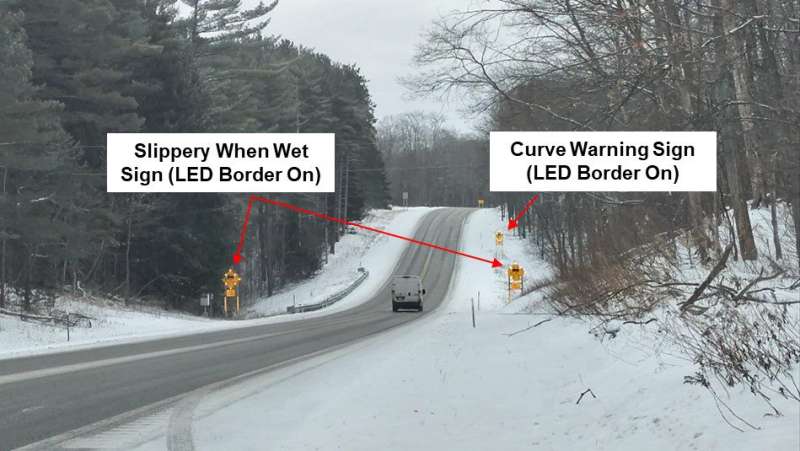
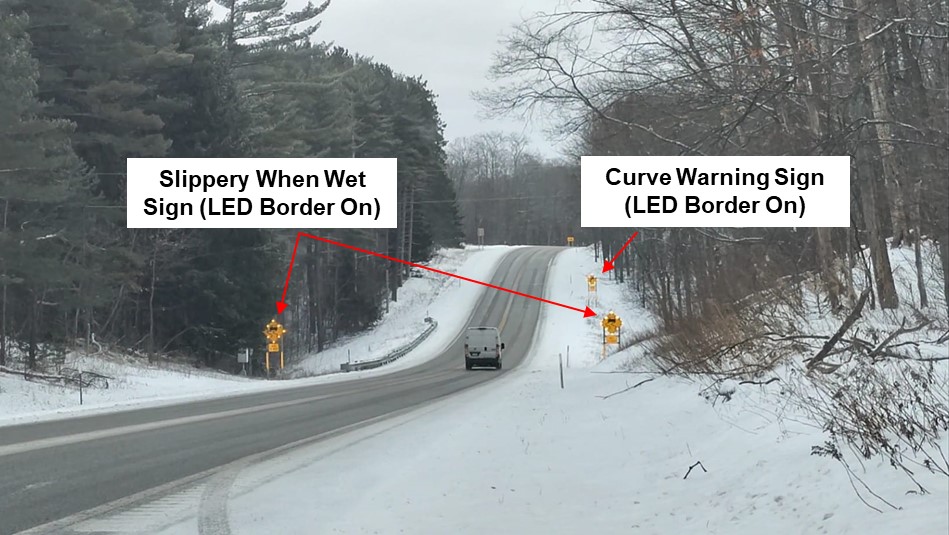
Now a new study done in Northern Michigan shows that flashing LED lights on signs near curves can successfully warn drivers to slow down during wintry conditions.
Curves can be deadly.
The state tallied 128,517 crashes on curved roadways during winter weather conditions between 2018 and 2022, causing 175 serious injuries and fatalities, plus 1,360 less serious and suspected injuries, the study said.
Curves on flat roads—called horizontal curves by highway engineers—“present a major challenge to drivers, especially when there is a significant difference between the posted speed limit and the curve advisory speed.”
Navigating curves becomes more hazardous when snow and ice reduce pavement friction, increasing the odds of a vehicle leaving its lane.
Horizontal curves are responsible for more than 25% of fatal crashes, and vehicles leave the road in most of those incidents.
Field testing of flashing LED lights took place along a 1.7-mile rural section of M-32 west of Gaylord. The two-lane undivided highway there has a posted 55 mph speed limit, while the curve has a 45 mph advisory speed.
The slippery curves study is part of a larger project looking for effective speed warning technologies, said Timothy Gates, a professor of civil and environmental engineering at Michigan State University. The research is funded by the Michigan Department of Transportation.
MSU researchers used sensors to collect data on pavement conditions and tested on days with early morning snowfall that tapered to overcast or light snow by midmorning, the study said. Air temperatures ranged from the upper 20s to lower 30s.
LED lights on the borders of “slippery when wet” and “curve” signs were programmed to automatically activate in 30-minute cycles during adverse conditions.
The signs “had a significant speed reduction effect for drivers approaching the curve during winter weather conditions,” according to the study published in the journal Transportation Research Record.