Fall is officially starting to show up in Michigan, with the first bursts of red and orange shades now appearing across the Upper Peninsula. And if you’re itching to hit the road to take it all in, there are plenty of scenic spots to choose from.
Today, we’re taking a look at some of the state’s best fall color road trips, along with the latest estimates for when peak color will arrive in different parts of the state.
Also in today’s newsletter, we’ll take a look at Lansing’s “Restoring Roots” project, which looks at planting trees in disadvantaged neighborhoods that have historically had less tree cover and greater exposure to heat.
And closing out, Michigan’s independent food retailers say the state’s bottle redemption program needs an overhaul. We’ll hear from readers on what they would change.
Let’s dive in.
|
|
|
Absentee ballots now available to Michigan voters (The ‘Gander): Voters can request an absentee ballot by completing an absentee ballot application. Oct. 19. is the last day to register to vote by mail or online. Starting Oct. 20, you’ll need to register in person at your city or township clerk’s office with proof of residency.
Lawmakers consider battery recycling program (Michigan Advance): Michigan lawmakers are considering a battery stewardship program that would require battery sellers and distributors to arrange for convenient and free collection of used batteries statewide. Lawmakers say the program could reduce fires caused by improperly discarded lithium-ion batteries.
Disease suspected after dozens of dead deer found in Saginaw area (Bridge Michigan): A Burton man who found at least 30 dead deer in and around the Shiawassee River State Game Area says the scene was unlike anything he’d seen before. Michigan DNR officials believe the die-off is likely caused by epizootic hemorrhagic disease, a seasonal virus that can cause deer to become feverish and dehydrated and often sends them into water seeking relief.
|
|
|
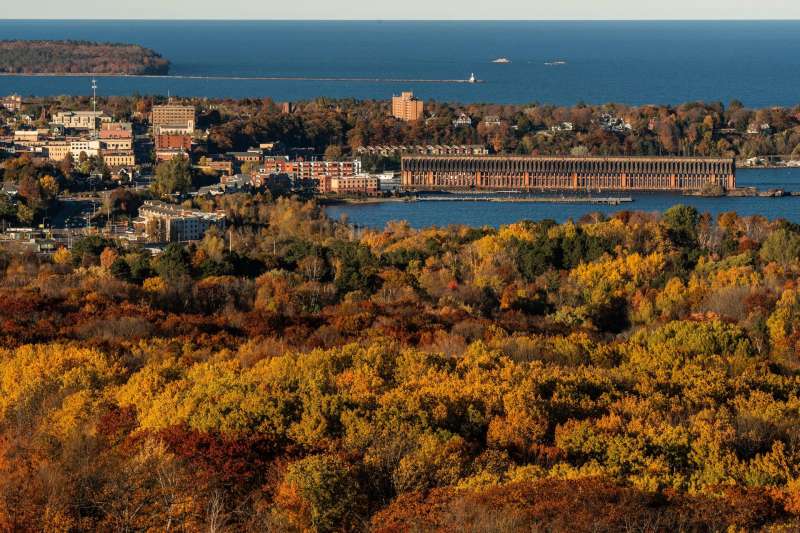
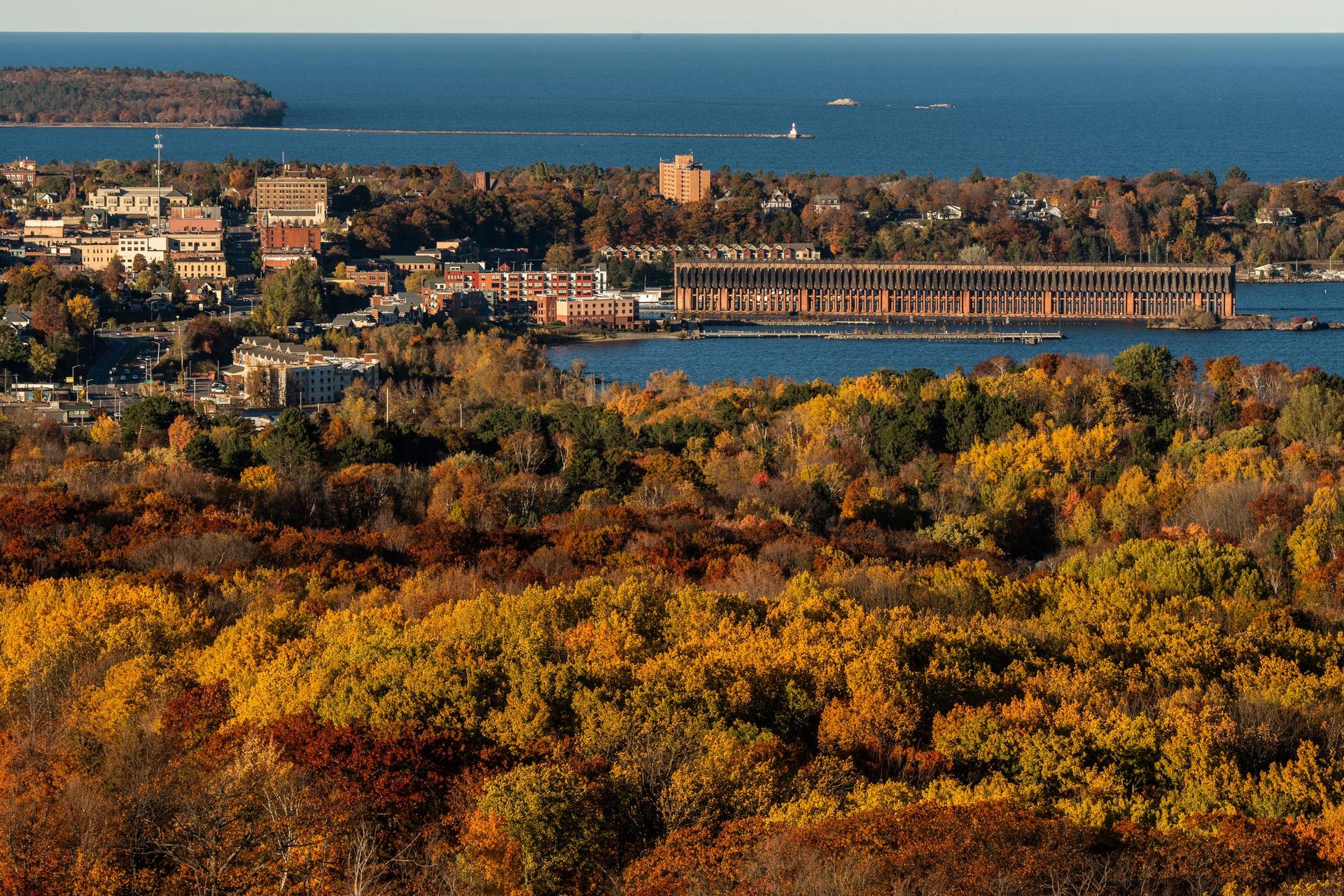
Fall color fills the landscape overlooking downtown Marquette from atop Mount Marquette as the sun sets in Michigan’s Upper Peninsula on Tuesday, Oct. 28, 2025. (USA Today Network)
|
By USA Today Network via Reuters Connect
Michigan is welcoming the start of fall, and leaves on trees are beginning to change colors in the Upper Peninsula, offering a stunning display to admire on an autumn road trip.
The peak times to admire the fall colors in Michigan vary based on where you are in the state. Generally, peak times range from late September through early November, according to the century-old publication the Old Farmer’s Almanac.
Foliage in the western UP has begun changing colors and the change is beginning to spread east across the peninsula, and southward, according to Explore Fall’s Michigan Fall Foliage Map 2026.
In the UP, consider stopping at Tahquamenon Falls State Park, or to the west, Porcupine Mountains Wilderness State Park or Copper Peak to enjoy panoramic views of the multi-colored natural display.
The entire state is expected to see leaves begin to change by the first week in October.
Here’s what to know about fall color drives in Michigan.
|
|
|
Shade, cooler temperatures and improved air quality are among the reasons Lansing’s “Restoring Roots” project targets disadvantaged neighborhoods that have historically had less tree cover and greater exposure to heat. (Demonte Thomas)
|
By Demonte Thomas, Capital News Service
For someone waiting at an unsheltered bus stop along Michigan Avenue in Lansing on a hot summer afternoon, the benefits of urban trees can feel tangible.
Such bus stops meet the city’s definition of a “heat island,” an area that has less shading and hence more intense heat.
Shade, cooler temperatures and improved air quality are among the reasons Lansing’s “Restoring Roots” project is targeting disadvantaged neighborhoods that have historically had less tree cover and greater exposure to heat.
The $5 million federal-grant project, which was first announced in 2024, is now two years into its five-year window. City officials are reviewing community feedback gathered through surveys, public meetings and outreach events before making final decisions on where trees will be planted and what species will be selected.
Lansing sustainability manager Lori Thomas said the city, which has spent $570,000 so far, has identified 15 to 20 eligible disadvantaged areas for tree planting. Examples are “bus stops or shopping areas with no shelter or trees, or downtown where there are dense buildings, sidewalks and parking lots, etc.,” she said.
She said community members have embraced the process.
|
|
|
Earlier this week, I shared a story about independent store owners in Michigan who are calling on the state to revise its Bottle Bill, arguing that it’s an economic burden on top of being unhygienic.
But I wanted to hear from Michiganders too, so I asked:
|
Does Michigan’s bottle return system need an overhaul? What would you change?
|
We got a lot of traction on this question, so if you don’t see your answer down below, worry not. I plan to do a full write-up with the rest of the responses in the coming days.
Here’s a snapshot of what you had to say:
“I think grocery store owners should suck it up and keep letting Michiganders return our bottles. I think the bottle return bill has done amazing things for our lakes and land. It’d be a shame to lose such a unique Michigan thing!” — Nate, Grand Haven
“This is a law that makes Michigan stand out. No broken glass on roads or bottle trash in our parks. Never change the law, increase the deposit if need be.” — Kevin Ann Arbor
“While I agree that the 50 year old bottle return bill needs to be updated, it sounds like retailers (who have been against it from the start) want it to end before an alternative is in place. That can’t be allowed to happen.” — Jennie, Ann Arbor
“Simplify the return bottle process by adding bottle returns stations outside stores and have them take all bottles and cans regardless of whether they sell them. These outdoor stations should be maintained by the stores. Apply to large stores with a certain volume of sales. Smaller stores who collect the deposit fee should pay that fee to the larger store for handling the mess. As a regular bottle return customer, part of the problem is that often the return stations are broken and one must make multiple trips to multiple stores which can necessitate longer storage times in the garage.
Reusing and recycling should be made as easy as possible!!!” — Sharon
“Michigan’s bottle return law needs updating to bring it in line with original purpose of the law: to prevent containers being discarded as litter along roadways and in public parks. There are so many more products bottled & canned for quick individual consumption that were never imagined back then such as teas/coffees, non-carbonated drinks, and the plethora of bottled waters. The law also excludes ciders & “hard” ciders & wine & liquor. Look in any trash bin at store bottle recycling areas and you’ll see lots these non-returnable items. They wind up at store recycling areas because they don’t know bottle return rules (people who are college students from other states or recently moved to Michigan) or recognize the nuances (i.e. name brand energy drinks that have carbonated & non-carbonated versions or the hard cider exemption). Add to that confusion the reverse machines not being updated for UPCs of new brands/new container sizes/new flavors the store is selling. One store manager told me it was a long process to get their distributors to get them permission to add UPCs to machines (true?). A long term bottle return room employee told me he used to make lists of the cans/bottles that their machines weren’t accepting so the UPCs could get added but he kept seeing the same stuff not being accepted so he just stopped making his lists. And more frequently of late I’m seeing cans with blurry UPCs the machines can’t read. And some store bottle room employees give you a hard time about giving you slip for the cans sold at the store that didn’t scan. Conversely, I’ve seen irate/abusive customers giving the bottle room staff grief for not giving them a slip for bags/carts full of filthy cans the staff isn’t required to accept per law. Also, as article states, the cost of equipment and maintenance/ cleaning (a lot of filthy/leaky cans go thru those machines) of reverse vending machines; cost of use of store space, cleaning of space (people can be pigs), & staffing; and though bigger stores can have separate space for bottle room, the space is still connected to the store so hygiene is also of big importance (again, people can be pigs who don’t rinse out their cans/bottles or sometimes even don’t empty them of liquids or added lemon/lime wedges that have molded or tobacco/CBD pouches, straws, food, & food wrappers jammed inside). Think maggots, insects, & all things disgusting beyond just a dirty/sticky can/bottle.” — Barb, Ann Arbor
“I agree it should be updated…..to include all beverage containers. It’s silly that a hard cider can does not have a deposit but a seltzer does. I’ve been charged deposits on cans with no refund. It’s not the retailers fault. Too much to keep track of. Simplify the whole thing by charging deposits on all bottles and cans. People will return them then.” — Bob, Kalamazoo
|
And if you have a question you’d like me to ask our community, send it my way. I might feature it in a future newsletter.
*Responses may be edited for conciseness or clarity.
|
|
|
Enjoying this newsletter?
|
|
|
|
You are receiving this email because you opted in via our website.
Our mailing address is:
The ’Gander / COURIER Newsroom
3229 Greenpoint Ave., PMB 532
Long Island City, New York 11101
Want to change how you receive these emails?
You can update your preferences or from this list.
|
|
|
|